Love is not supposed to hurt

Image result for domestic violence in black community

Today is Valentine’s Day.  Dinner reservations have been made and the night will bring flowers, candy, and cards.  For some women however, the dinner will be thrown to the floor in anger, cards will be ripped to pieces, and nothing sweet will pass her lips.  For them, the night means walking on egg shells in fear and fists driven into her chest and back.  For some, the one they love, the one they call husband, boyfriend, or partner is the one who inflicts the most pain.  Pain borne out of insecurity.  Pain borne out of misplaced blame.  Pain borne out of pure evil.  Love is not supposed to hurt.  But the chances are you know a woman that is in an abusive relationship and the beatings have become her norm.

Like many crimes, blacks are disproportionately represented as victims of domestic violence and intimate partner violence.  Black women are 35% more likely to be victimized by a partner than white women (NCADV, 2017).  Black women are also three times more likely to be killed by an intimate partner.  Among black women ages15-35, domestic violence homicide is one of the leading causes of death.  Love is not supposed to hurt.  Love is not supposed to hit.  Love is not supposed to kill.  This is not love.  Sadly, these victims often suffer in silence.  They do not tell because they truly love their partners.  They do not tell because they are embarrassed.  They do not tell because leaving may mean loss of financial support.  And they do not tell because they do not want to hand their man over to the police, an institution that has historically brutalized black men.

Domestic violence and intimate partner violence is such a complex issue that often those on the periphery resort to victim blaming.  Further in some communities of color this phenomenon is normalized with abusers given a pass.  This behavior is not normal.  Using the body of a woman as a punching bag to work out one’s anger is wrong, monstrous, and criminal.  The black community needs to confront this issue and bring it out into the open.  Increasing awareness, knowing the signs of abuse, and providing access to resources for victims and their support system are key.  These statistics no longer need to be our reality.  Our young girls and women deserve more and need our help.  Let’s end this now.  Change the norm.  Know the signs.  Acknowledge the behavior.  Condemn abusers and help the victims.

Be safe,

L.J.
Follow me on Twitter: @CrimeDoc1213/@Cupids_Sting
Follow me on Instagram: @cupidssting

#ValentinesDay #love #hurt #domesticviolence #intimatepartner #violence #EndDV #abuse #violenceagainstwomen #endthisnow #crime #justice #support #knowthesigns #help #protectourgirls #protectourwomen #cupidssting #nonprofit #MeToo #TimesUp #LaurieSamuel #crimedoc

The National Domestic Violence Hotline may be reached at 1-800-799-SAFE (7233).

References

Jones, F.  (2014).  Why black women struggle more with domestic violence.  Time.  Retrieved from http://time.com/3313343/ray-rice-black-women-domestic-violence/.

National Coalition Against Domestic Violence.  (2014).  Domestic violence fact sheet.
Colorado: National Coalition Against Domestic Violence.
 

Real Talk on Domestic Violence

image

Chances are you know someone that has been abused. Chances are you have seen a couple argue in public.  Chances are someone has put their hands on you, shoved you, or spoken to you in a loud, harsh, demeaning manner that could only be described as verbal abuse.  However you define it, it is all abuse.  And we need to do something about it. Females are being victimized younger and younger as they enter the dating world earlier, some as early as middle school.  We do not need anymore violence against women and we do not need any more killings at the hands of an intimate partner.

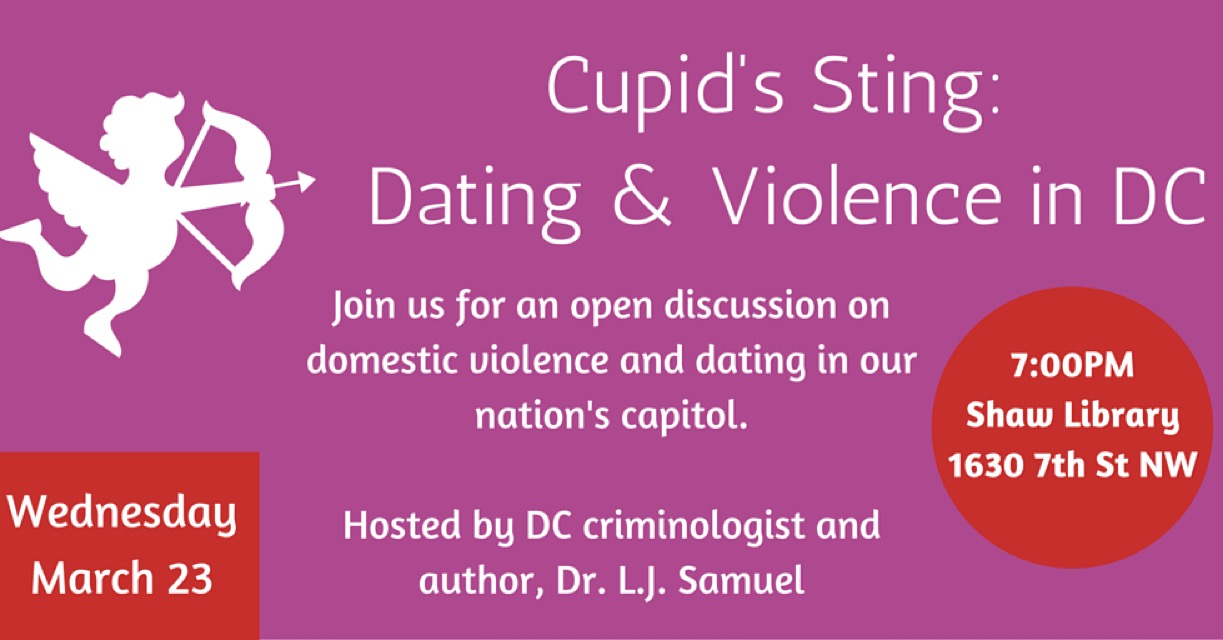
On Wednesday, March 23, 2016, there will be a discussion on this very issue at Shaw Library in Washington, DC.  This is a free community event so come out and lend your ear and contribute on ways to combat this crime and social disease.  Bring a friend or bring a young lady new to dating or bring an older woman who is more seasoned.  We need you all there!

There will be a social hour with refreshments and an opportunity to network with other women.  Please RSVP at bit.ly/1QDK4eC

Be safe,

L.J.

Follow me on Twitter: @CrimeDoc1213

#domestic violence #dating #violence #onlinedating #singles #singlewomen #singlepeople #DC #DMV #DCdatingscene #WomensHistoryMonth #crime #justice #solutions #dontblamethevictim #ljsamuel #deardiary


Confidence or Compromise? Love, Dating, and HIV/AIDS

loneliness

I attend a weekly women’s bible study at my church where we are currently studying Joyce Meyer’s book Confident Woman. Each week our bible study leader Reverend Adriane Blair Wise dissects this text as she teaches and reveals that God did not intend for women to live in fear and self-doubt but to be bold and confident as we navigate this thing we call life (Meyer, 2006).

Unfortunately for some, the message does not resonate and they end up making bad decisions that impact and change their lives forever.  In this blog post I want to touch briefly on the dangerous compromise some women make in the name of loneliness.  This discussion surrounds the high incidence of AIDS cases among Black women in the United States.

Here are the staggering facts:

  • Black women account for 66% of new HIV infections among women
  • 84% of all HIV/AIDS infections among Black women come from heterosexual contact
  • HIV/AIDS is the third leading cause of death among Black women ages 25-44
  • Black women are over 20 times more likely to be infected with HIV/AIDS than their White counterparts

I can barely wrap my head around these figures.  In the past several decades, we have learned so much about this deadly disease and know that contraction is preventable.  So, what is going on to explain these rates?  Research points to poverty, feelings of denial in the Black community, the Down Low phenomenon, and loneliness.  In the Black community, there appears to be a shortage of mates for Black women due to a lack of availability of Black male counterparts.  Incarceration and perhaps lack of interest in pairing up with Black women are other reasons Black women may find themselves alone. Whatever the reason for the lack of Black female to male pairings, it has created a situation where some are engaging in dangerous sexual behaviors.  There are some Black men leading double lives and are sleeping with both men and women.  Or men incarcerated for long periods of time are engaging in same sex encounters and introduce HIV to their partners upon their return from prison.  Due to the belief among these men that they are straight despite having intercourse with other men, they are playing Russian roulette and are having unprotected sex.  Their female partners are oblivious and many have contracted the disease as a result.

The loneliness factor is an even more compelling reason as to why there is such a high incidence of HIV/AIDS among black women.  Instead of being alone, some women are willing to share their men, which increase their risk of contracting the AIDS virus.  What is so sad and disheartening is the fact that many Black women define their self-worth based on having a man.  I know this to be true based on the bemoaning of friends, acquaintances, and co-workers.  When you look at these women from the outside, you would want to be them.  They are beautiful, attractive, highly educated, have great careers, and have everything money can buy.  But their confidence is masked by these things because all they really want is someone to curl up beside them at night, to be loved, and to feel safe.  In this powerful desire to be a part of ‘something,’ they compromise their values and forget or push aside what they have learned for a brief moment of passion so they feel important, however brief that time is.  They forget that God created her in His image and they forget that they should never compromise the wonderful gift that they truly are.

When talking about HIV/AIDS, compromise simply is not an option.  This is a terrible, ugly, painful, and deadly disease.  Women must learn to love themselves first.  If God has a man for you, then one day he will find you. In the meantime, we need to learn how to enjoy ourselves, our families, and life until that time comes~ boldly, assuredly, and confidently.

Be safe,

L.J. Follow me on Twitter: @CrimeDoc1213

#love #dating #HIV #AIDS #confidence #compromise #ConfidentWoman #loneliness #death #disease #blackwomen #rates #selflove #female #empowerment #ljsamuel #deardiary

References

Black Women’s Health Imperative (2013). Black women and HIV/AIDS. Retrieved from http://www.bwhi.org/issues-and-resources/black-women-and-hiv-aids

Centers for Disease Control and Prevention (2015). HIV Among Women. Retrieved from http://www.cdc.gov/hiv/risk/gender/women/facts/index.html

Cohen, J. (2004, October 27). A silent epidemic? Why is there such a high percentage of HIV and AIDS among black women? Slate. Retrieved from http://www.slate.com/articles/health_and_science/medical_examiner/2004/10/a_silent_epidemic.2.html

Henry J. Kaiser Family Foundation (2014). Black Americans & HIVAIDS. Retrieved from http://www.kff.org/hivaids/fact-sheet/black-americans-and-hiv-aids/

Meyer, J. (2006). The confident woman. New York: Faith Words.

Weathersbee, T. (2004). Commentary: More afraid of loneliness than AIDS Deaths. Retrieved from DCSistagirlslistserv.

Image: worldsstrongestlibrarian.com