Shades of Gray

Freddie Gray

Yesterday Freddie Gray, age 25, was buried after succumbing to injuries he sustained at the hands of several Baltimore Police Department officers. No one knows exactly what happened that terrible day on April 12, 2015 and perhaps no one ever will. But one thing is for certain- Mr. Freddie Gray is dead. His twin sister has lost her brother, his parents have lost their son, and the world has lost another young black man to police brutality. The media consistently reports that Freddie died of a spinal injury but official reports state that his spine was severed, an injury so severe that it took his life. Semantics? I think not. If we are going to have a real discussion on the issue of police brutality, accountability, police-community relations, and steps towards healing then we must not sugarcoat the issue. 25 year-old Freddie Gray died after officers stomped on his back and severed his spine ending his short life. They gave Freddie Gray a life sentence for allegedly having guns in his possession. These officers acted as the judge and jury and unfortunately Mr. Gray did not have a chance.
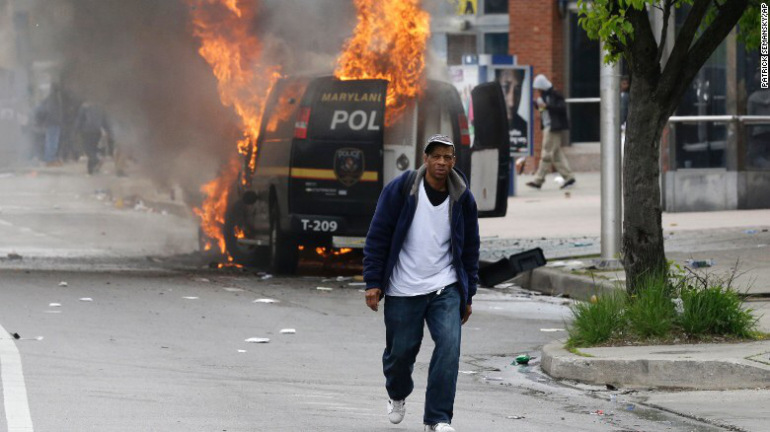
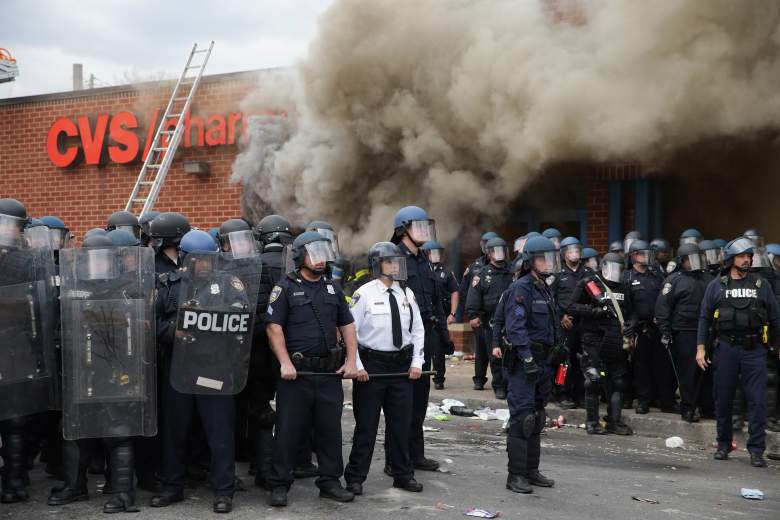
Police Vehicle Burning    CVS Burning

The match was lit and Baltimore burned for the better part of the afternoon and night of April 27th. While many protested peacefully in the street, others used it as an opportunity to engage in lawlessness. Baltimore residents are angry. Those watching around the country and world are angry. We are all angry. But how does breaking into a liquor store or destroying a CVS Drug Store further the cause in a positive manner? How does bad behavior honor the spirit of Freddie Gray or comfort his family? It doesn’t. It is an unnecessary distraction and confuses the agenda. For those rioting in Baltimore, they are in the minority and they are punishing no one but themselves. They open themselves up to arrest, prosecution, jail time, and have physically destroyed segments of their own communities.

The Governor blamed the mayor for not acting soon enough and the National Guard was called in to occupy another city exploding from the frustration and anger of police brutality and unnecessary force. Not acknowledging the real problem feeds into the Us versus Them mentality between the police and the black community and broadens the divide between these two groups. It is absolutely mind-boggling that in 2015 we as a society are here again. With all that occurred in Stamford, Florida, Staten Island, NY, Ferguson, MO, Tulsa, OK, and many other cities, you would think that we would have learned. Leaders need to truly step up and take action that will be lasting and leave the recycled rhetoric in the past.
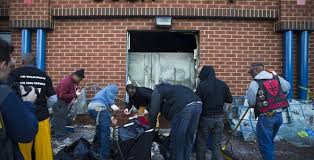
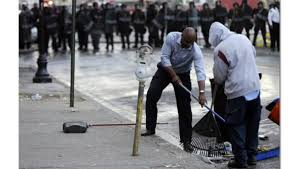
Community Clean Up  Rakes_telesurtv.net

The good news is that every day we are provided with a new opportunity to start over and get it right. And this morning, residents of Baltimore let the rioters in the community, their fellow neighbors, and the country know that they were not going stand by and let their city be destroyed. So people pulled out their brooms and got out trash bags and started the slow process of cleaning up. This gesture is creating an atmosphere of solidarity and perhaps the healing has begun. The world is still young and we all must live in it together so why not do that from a place of love and respect? Surely that’s better than putting fires out.

Be safe,

L.J.
Follow me on Twitter: @CrimeDoc1213

#FreddieGray #policebrutality #policeabuse #Baltimore #BaltimoreUprising #policeaccountability #blacklivesmatter #crime #justice #peace #healing #death #future #hope

Images courtesy of:
http://www.wbaltv.com
http://www.heavyeditorial.com
http://www.townhall.com
http://www.telesurtv.net
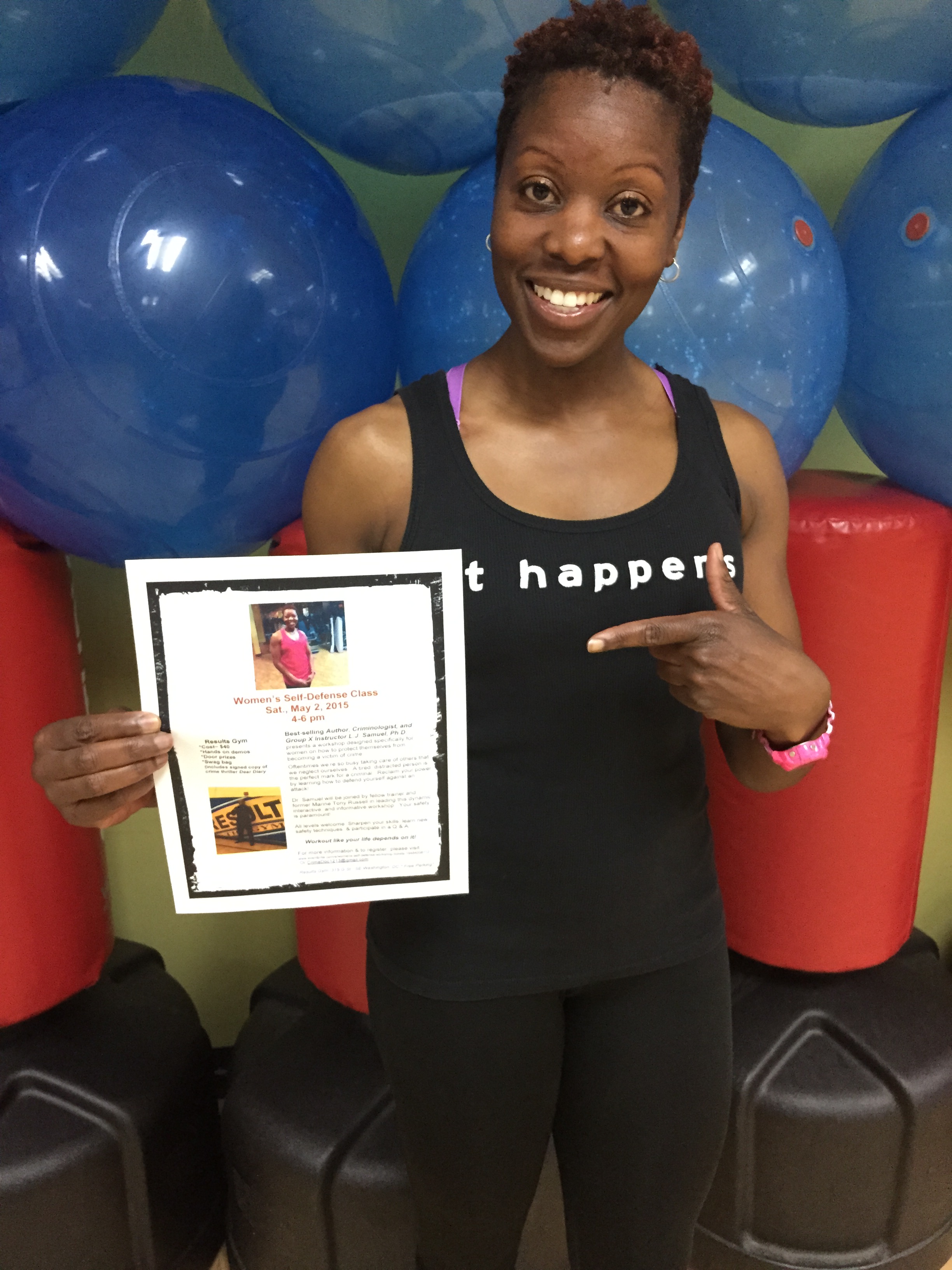
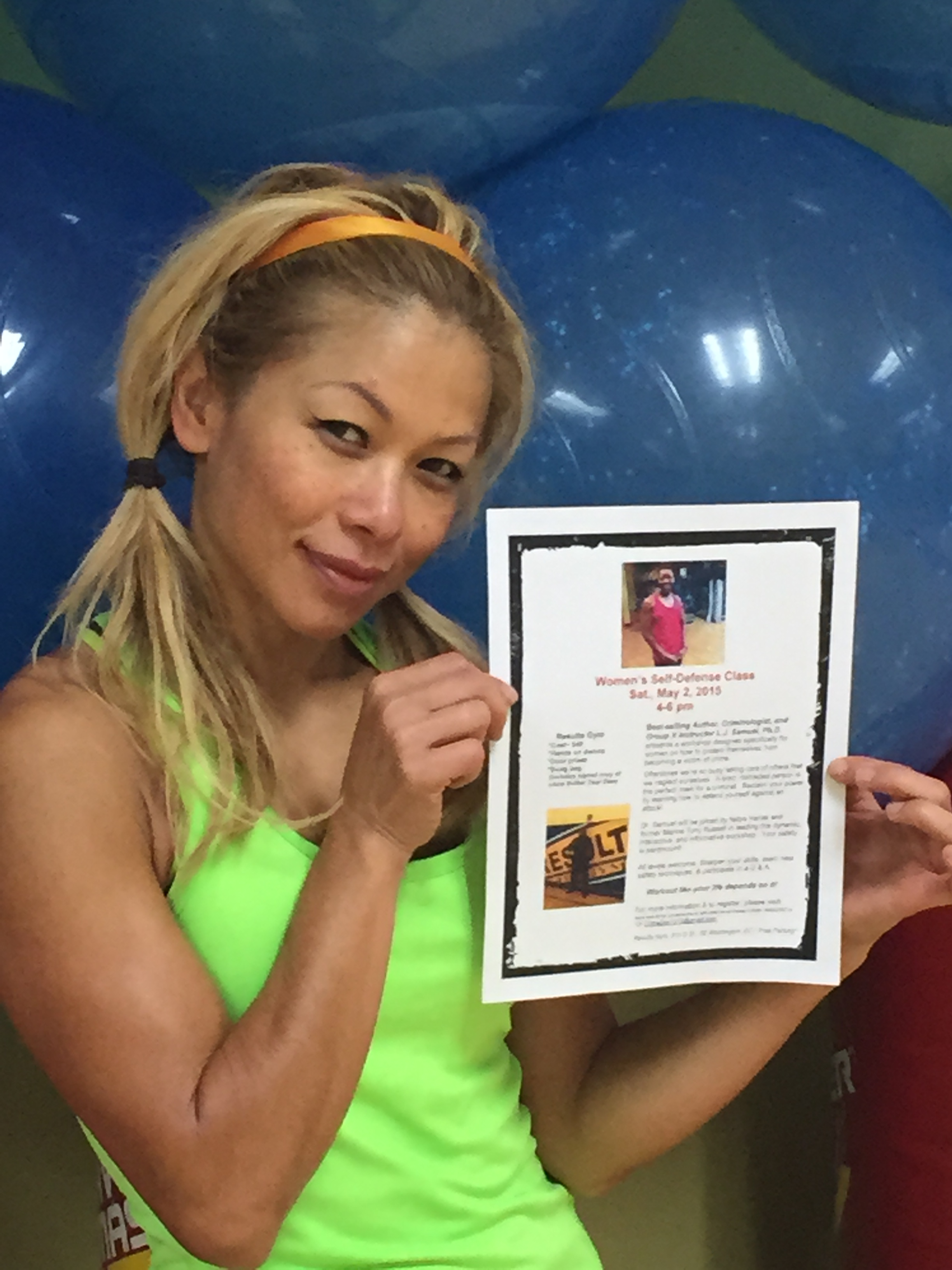
Women’s Self-Defense

IMG_4505  IMG_4483

Oftentimes, we are so busy taking care of others that we neglect ourselves.  Between work, family, grocery shopping, homework, and little sleep, we run ourselves into the ground.  A tired and distracted person is the perfect mark for a criminal.  Reclaim your power by learning how to defend yourself against an attack!

If you live in the Metropolitan Washington, DC area, please join me on May 2nd, 2015 from 4-6 pm for a Women’s Self-Defense class. The class will be held at Results Gym, 315 G Street, SE.  There is plenty of free parking and it is Metro accessible.

Workout like your life depends on it!

Be safe,

L.J.
Follow me on Twitter: @CrimeDoc1213

#womensselfdefense #selfdefense #victimization #safety #defense #crime #justice #care #strength #courage #Results #dontbeavictim #ljsamuel #deardiary

Incarcerated Fathers

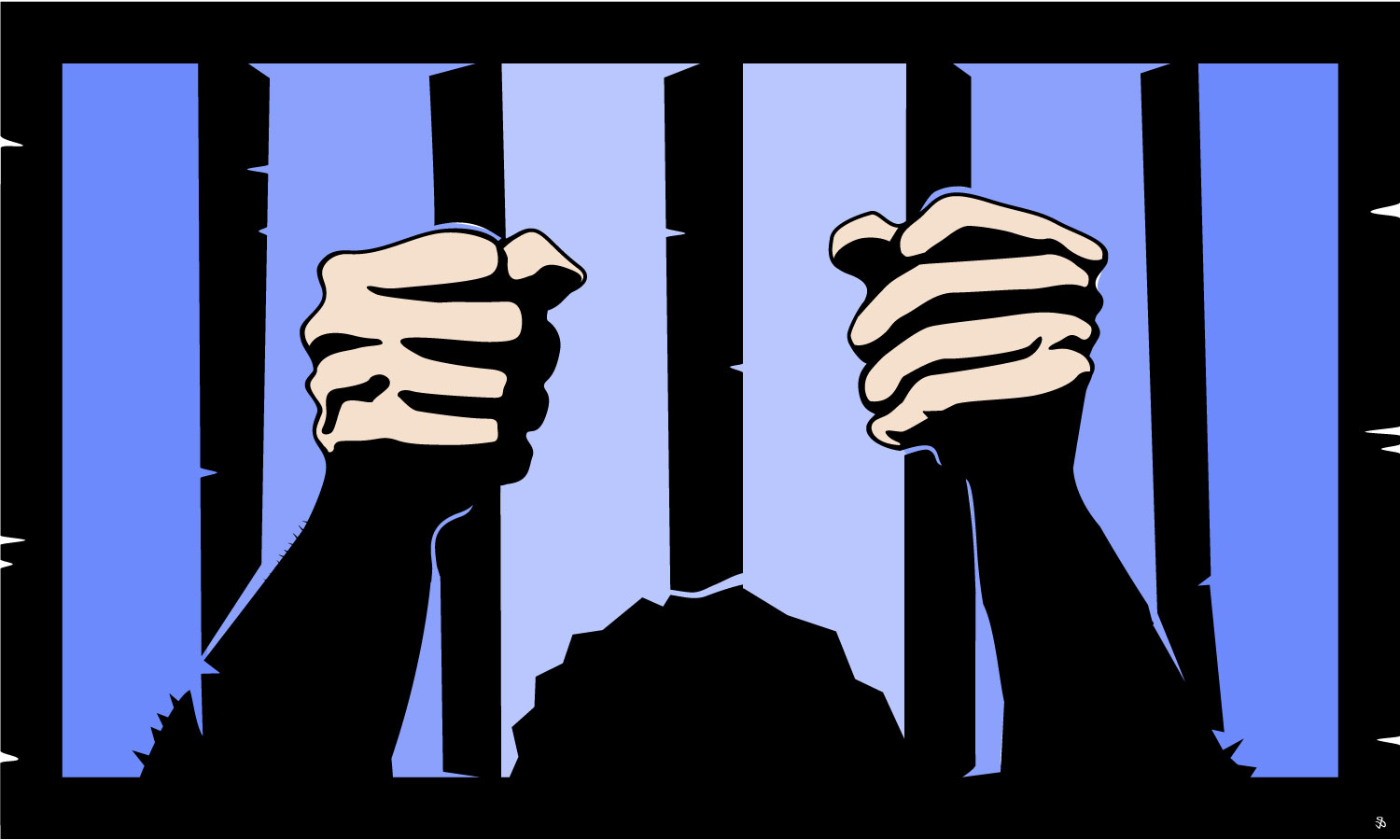
Prison Bars

Children who have parents that have been incarcerated are five times more likely to spend time in prison when they become adults compared to children who have never had an incarcerated parent (Urban Institute, 2003).

Crime is leveling out in the United States yet there are scores of people still being warehoused in prisons across the country.  The majority of these prisoners are parents.  The incarceration of a father has a devastating impact on the family unit, namely because of the huge financial loss.  Furthermore, when daddies are locked up, there is a strain on spousal relationships, a disruption in the parent-child relationship, and the loss of a ‘father figure.’  Using an excerpt from an interview of a father returning from prison, this post looks at the impact of incarceration on the family unit and its resulting financial, emotional, psychological, social, and community costs.

The subject of this interview was imprisoned for armed robbery.  When he entered prison, he had two young boys, aged 3 and 5 and spent a total of 10 years in prison for his crime.  The following is an excerpt from the interview:

Samuel: What were your experiences and those of your family?

Subject Father: “I was more distant from my family. As time went on, there was less communication with me and more negative thoughts placed in my kids’ heads.”

Samuel: What changes did your family go through?

Subject Father: “They found themselves going to foreclosure and eventually lost the house.  From that point they wandered from family and friends and in and out of different apartments.  My kids developed discipline problems at home and at school.  When I came home, they were more belligerent and they would not listen to me.  I found the relationship with my kids to be distant.  Not what it was before I left.  My wife caught the attention of other men while I was locked up and we eventually separated and divorced.”

Samuel: Did you maintain ties with your family while you were locked up?

Subject Father: “Yes, mainly through letters and phone calls.  The kids were too young to read.  I had three visits from my family while I was in prison.  My kids’ mother was more supportive in the beginning but as time went on, we became more distant.

Samuel: What other changes did you experience?

Subject Father: “When I came home, there were a lot of changes.  I had to re-adapt to society and find other support through friends to help financially and mentally to make change.  I had to re-invent myself.  I got my CDL license in order to find another job and get in the workforce.  On prison, you don’t want to be there because a lot of things that happen in prison stay in prison.  You have to re-adapt to a whole other type of society in prison.  There are things you should do and not do and I would never want my kids to experience that.  Never!”

While this is only one illustration of what happens to a family unit when a father is locked up for several years, our subject father’s story is commonplace among communities and cities in this country.  There is no arguing the fact that if someone commits a crime they should be held accountable but the resulting impacting on children and families cannot be ignored.  And the sad fact is that one’s criminal act is often the spark that ignites the never-ending cycle of poverty, unemployment, substance abuse, and crime.  I just hope the future is brighter than the past and present situation.

Be safe,

L.J. Follow me on Twitter: @CrimeDoc1213

#incarceratedfathers #incarceration #prison #crime #justice #cycle #poverty #delinquency #family #fatherfigure #future #hope

 References

Samuel, L. (2004). Family issues: The impact of an incarcerated father on the family unit (Unpublished paper). Howard University, Washington, DC.

Travis, J., McBride, E., & Solomon, A. (2003). Families left behind: The hidden costs of incarceration and reentry. Washington, DC: The Urban Institute.

Image source: imgkid.com

Long Hair, Fair Skin: The Depiction of Beauty in Hip Hop

*After a brief hiatus, I am back with another blog post. I hope you enjoy it!

Long Hair Fair Skin

The Hip Hop Industry is a multi-billion dollar platform with wide-range appeal across all sexes and races. Unfortunately, the representation of black women in hip hop along with its accompanying videos is skewed, leaving the viewer with the concluding thought that “beauty” means long hair and fair skin.  Thus, in order to make it to the video screen, the attractive female lead must meet these criteria.

Not only do these images shape perceptions of the black community as a whole in terms of speech, dress, and actions.  But, according to the Cultivation Hypothesis, when people are exposed to “homogeneous representations of social relations” they begin to believe these limited images are reality (Gandy & Baron, 1998: 513). But whose ideals are these images truly based on?  Are they a true representation of the people on display or are mainstream ideals pushing these labels?

What is the common image of a beautiful “video chick?”  Normally she is petite, has a light complexion, long flowing hair (that may or may not be hers), light eyes, and a curvaceous body (Samuel & Brailey, 2004).  There are scores of people consuming these images.  Images that make judgments about beauty and attractiveness and if Drake or L’il Wayne say so, then it must be true.  These images however are but a subset and leave out a majority of beautiful black women who are not and should not be defined solely by their bodies.  So, if you don’t pass the brown paper bag test, then you’re not beautiful? We have to be better than that.

A 2004 Howard University study of black music videos found that the female lead in hip hop and R & B videos was overwhelming a young, attractive, fair skinned woman with long hair.  Many of the women featured were mixed race and played a subservient role to the featured male artist and his entourage (Samuel & Brailey, 2004).  The subservient video girl is your atypical ‘hoochie’ who is almost always scantily clad, placed in sexually inviting positions, and is always willing to please. The beautiful video girl thus is transformed into a sex object whose body serves as the landscape for mainstream ideals, politics, and cultural objectives.  When definitions of black beauty and black female sexuality are defined using this one narrow construct, which is false, based on mainstream ideals, and designed to keep black women in subservient positions, the video girl (i.e. black woman) is reduced to her body parts and her value diminished.

Beyoncé is not the only barometer of what is beautiful.  I mean seriously, do you think she woke up like that???  Let’s start to shed these images and ideals and become more accepting of the unique, diverse, magnificent rainbow of beauty as all women should not be painted with the same make-up brush.

Be safe,

L.J.
Follow me on Twitter: @CrimeDoc1213

#LongHair #FairSkin #hiphop #music #videos #beauty #beautiful #hoochie #blacksexuality #consumption #female #empowerment

References

Gandy, O. & Baron, J. (1998). It’s all in the way you look at it. Communication Research, 25 (5), 505-527.

Ogunnaike, L. (2004, January 12). Sweeten the image, hold the bling-bling. New York Times. Retrieved from http://www.nytimes.com/2004/01/12/arts/music/12HIPH.html?

Robinson, M. (2000). The construction and reinforcement of myths of race and crime. Journal of Contemporary Criminal Justice, 16 (2), 133-156.

Rhym, D. (1997). “Here’s for the bitches: An analysis of gangsta rap and misogyny. Womanist Theory and Research, 1(2), 63-68.

Samuel, L. & Brailey, C. (2004). Long hair, fair skin: The depiction of “beauty” in black urban music.   Paper presented at the annual meeting of the Southern Sociological Society Conference, Atlanta, GA.

Photo Source: Google Images (Bodybuilding.com Forum)

System Failure

What do you do when the system fails a young, poor girl? Who is to blame? What is the remedy for the cycle of poverty?

Meet Jordan.  She is 15 years old and in the seventh grade.  From the start of her life, Jordan was doomed.  When Jordan’s mom was pregnant with her, she smoke and drank almost every day.  In an interview, Jordan’s mom admitted to a daily consumption of 14 beers and at least one pack of cigarettes.  Jordan was the sixth child born to her 31-year-old mother.

Jordan came from meager beginnings. Both her mother and father have criminal records and her two older brothers are in prison for murder. Jordan grew up in a one bedroom apartment with eight other people in a rough neighborhood in Washington, DC. As the only girl, she really had to fend for herself. She started getting into trouble in kindergarten where she was suspended several times for fighting. She had a hard time paying attention at school and grasping simple concepts so she lashed out as a way of coping. Perhaps the substances her mother consumed while she was in the womb coupled with the social environment she was being reared in contributed to this behavior? When she came home from school, no one was there to read to her, go over her colors, or teach her to count.

Jordan survived off of potato chips, cereal, and orange soda.  When she went to middle school, she was held back- twice.  She fought any and every one because that’s all she was good at.  When she was 13 years old, she took money out of her teacher’s purse because her mom never gave her money for bus fare.  But she got caught and was arrested and so began her life of crime.  Her older brother accompanied her to court and told her what to say to her public defender.  And even though this was her first offense, she received three months’ probation.  She had to comply with the conditions such as staying out of trouble, going to school, getting good grades, and meeting with her probation officer but she did none of that because she was accountable to no one and no one was accountable to her.

So, here we have Jordan.  She was forced to grow up too soon.  She hangs out with the guys in the neighborhood during school hours because they take care of her. Besides, she doesn’t have time for school because soon Jordan is going to be a mother.

Be safe,

L.J.
Follow me on Twitter: @CrimeDoc1213

#systemfailure #cycleofpoverty #crime #justice

Note: names changed to protect identity of subjects.