Where are We Now? Remembering the Last Publicized Lynching in America

1981-lynching-of-michael-donald

Greetings all and welcome to the first blog of 2017 for the You Have the Right to Remain Informed.  The United States is getting ready to embark on a major transformation with the change of the Presidential Administration.  Today’s post features guest blogger Tammy Holt who shares a very personal story from her childhood in the Deep South.  Pay attention as we cannot allow history to repeat itself.

This has been a story hidden deeply in my memory bank since I was a little girl.  I remember living in Mobile, Alabama, and being told I could not go outside because a man’s body was hanging from a tree.  Of course, I blocked it out, but I always wondered was it really true or was it something that I remembered ‘incorrectly’, or did I dream it?

We stayed off Dearborn Street, a few streets over from Herndon.  The long story short is this young man was killed and hung by the KKK.  The KKK was mad that another black man was not convicted of killing a white police officer (the case was a mistrial).  So, in retaliation of the verdict, the KKK saw Michael Donald (I never knew his name) on the street, kidnapped, hung and cut his throat.  A gruesome murder.

https://en.wikipedia.org/wiki/Murder_of_Michael_Donald

This ties into current day news with Senator Sessions and his hearings for Attorney General.  He was on the team for the prosecuting attorney’s office back then.  I was reading up on all the issues surrounding him and his racial comments and found his connection to this case.  https://www.washingtonpost.com/news/fact-checker/wp/2016/12/02/jeff-sessionss-comments-on-race-for-the-record/?utm_term=.c6bcb8471c8d

In that Washington Post article (to give you the down and dirty), Sessions went all the way around and back again, saying he said some things, didn’t say others, said some things were taken out of context…yadda, yadda, yadda….my final opinion:  it’s between him and God.

But, I just wanted to share this information…you just never know how things in our lives will come full circle or how the news applies directly (or indirectly) to us.  I’m glad I can put some closure on this memory, but angered by the evil in this world.

I thank Tammy for having the courage to share her story and I leave you with this brief thought.  If the aim is to make America great again, does that mean that we have to go back to times such as these to achieve that goal?  I truly hope not.  As my friend Tammy has said before, “to be great, you have to be a servant.”  Thus, it is our hope and prayer that Sessions and the rest of new Administration will serve all people remembering equity and fairness.  As when you do right, we all benefit, grow, and evolve in the greatness God intended for us.

Be safe,

L.J.
Follow me on Twitter: @CrimeDoc1213
Check out what’s new in 2017 at www.ljsamuel.com

#race #racism #raceinamerica #1981 #lynching #MichaelDonald #Alabama #deepsouth #hate #love #black #white #civilrights #trial #Senator #JeffSessions #fear #light #healing #change #makeamericagreat #administration #crime #violence #criminals #justice #criminaljusticesystem #courtsystem #2017 #ljsamuel #cupidssting

Image source: https://www.pinterest.com/MetaRonin/black-history-americas-biggest-secret/


Police Brutality in the United States: The Past is Prologue

Past is Prologue Image                                            (What is Past is Prologue, Archives) McKinney Police Incident

In 1951, a Florida Sheriff shot two black men he was transporting in his police vehicle. The two men had been wrongly convicted of a crime. The victims, Samuel Shepherd and Walter Irvin were spared the death penalty after the US Supreme Court overturned their convictions (Equal Justice Initiative, 2014).  The Sheriff shot them shortly after the Supreme Court’s decision was made. The past is prologue.

In 1963, 700 black teenagers were arrested by the Birmingham Police Department in the State of Alabama. The police clubbed them with their Billy sticks, turned fire hoses on them, and attacked them with their police canines (Equal Justice Initiative, 2014). Their crime? Protesting racial segregation in the South. The past is prologue.

In 1979, the Los Angeles Police Department (LAPD) shot and killed Ms. Eula Love in her front yard.  Ms. Love was shot eight times by two LAPD officers who were called to the scene by the gas company seeking assistance in shutting off her service (La Ganga & Susman, 2014).  The past is prologue.

In 1980, white officers tied bags over the heads of some black males they were interrogating in the shooting death of a New Orleans police officer.  This came after four blacks were shot and killed by police in response to the slain officer’s death. The interrogation tactics violated police policy, federal law, and basic human rights.  Their actions led to a 1981 indictment (NY Times). The past is prologue.

In 1991, Rodney King was savagely beaten by 20 LAPD officers after a car chase.  Rodney King sustained 11 fractures after officers struck him over and over with their police batons and kicked him while he was on the ground.  Mr. King was unarmed.  The incident was caught on tape and sparked world-wide attention. The City of Los Angeles exploded and citizens rioted for five days (CNN Library, 2015). The past is prologue.

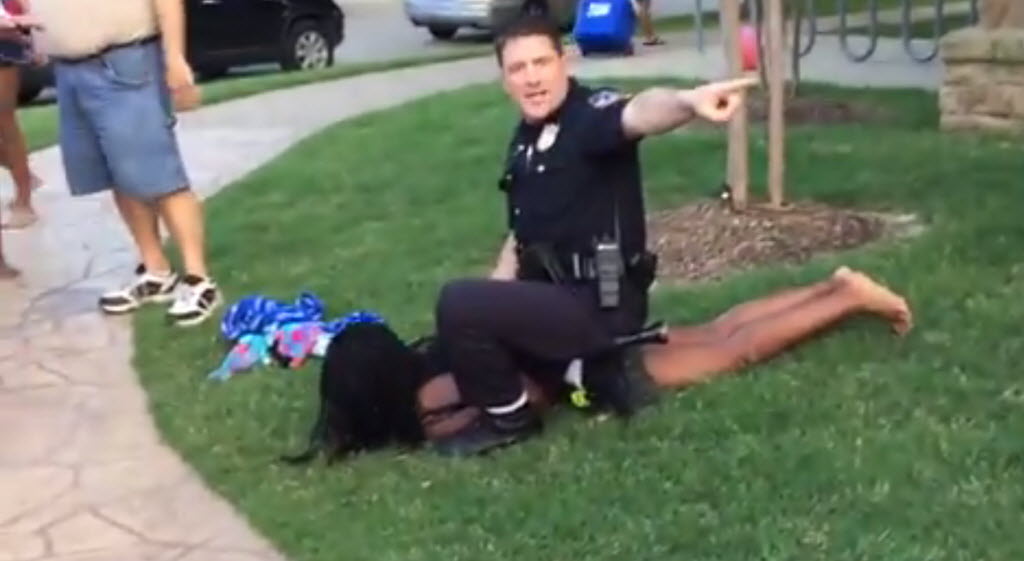
In 2015, a young, black 14 year-old girl wearing a two-piece bikini was forcefully thrown to the ground by an out of control police supervisor in McKinney, TX who was responding to a call about a pool party that had gotten out of control.  The white officer sat on the young girl’s back screaming obscenities at her and bystanders who yelled and cried for him to stop. The past is…wait, this just happened last week.

Police interactions with black citizens continue to be marred by fear, suspicion, and violence.  There is distrust between both groups that is based in history and experience.  But this incident in particular gives great pause as the victim in this case is a young female.  The officer was in full uniform with all his equipment, including his police issued firearm.  Where was the threat?  Sure, the teenagers outnumbered the officers but when you view the video, the kids showed deference and in fact were fearful and sat down and lay down on the ground when told.  This officer arrived on the scene angry.  Therefore, anything that was said to him was filtered through his blue colander.  There were other officers on the scene that were calm and spoke to the teens in a respectful manner but this one rogue officer was out of control.

As a trained Criminologist, if his case came across my desk, I would have recommended some extensive counseling beyond termination.  This officer was clearly out of control.  When he did a barrel roll across the grass and ran down the street, he appeared like a rabid animal.  When he pulled his gun out and pointed it at the group of teens, the incident turned the corner.  He had a clearly snapped. Even other officers on the scene tried to push him back and they should be applauded for that.  This was clearly a rotten apple.  Although this McKinney police officer acted individually, his position affords him such great power that these interactions are devastatingly dangerous.  Sadly, racism, oppression, and discrimination still exist.  They exist in all major systems such as education, health care, and the criminal justice system.  Perhaps this officer just snapped?  I doubt it.  I am certain that if you look back in his record, there was be a telling pattern of problematic behavior.  That being sad, he should never have been allowed to work out his problems on the young citizens of McKinney.  This is never a fun discussion but we need to set aside our feelings of discomfort and begin some real discussions on the issue of race in policing and how some are abusing their power and hurting people and communities in the aftermath.

There was once a time that when a ship was sinking attempts for rescue started with the most vulnerable victims: women and children.  Women and children have always been treated differently and at times, more gently.  For example, female officers are always (or should be) used to pat down females.  There is a societal rule in terms of how men versus women should be handled.  Thus, the outrage in social media after this case is warranted.  Certain behaviors and actions should be off limits and this McKinney officer went too far. Let’s do better.

Be safe,

L.J.
Follow me on Twitter: @CrimeDoc1213

#BlackLivesMatter #protectourgirls #McKinney #poolofoppression #policebrutality #police #accountability #pastispresent #socialjustice #criminaljustice #crime #justice #peace #compassion #dialogue #ljsamuel

References

CNN Library. (2015). Los Angeles riot fast facts. Retrieved from www.cnn.com/2013/09/18/us/los-angeles-riots-fast-facts/.

Equal Justice Initiative. (2014). A history of racial injustice. Retrieved from www.racialinjustice.eji.org.

La Ganga, M. & Susman, T. (2014). Controversial police use-of-force cases. LA Times. Retrieved from http://graphics.latimes.com/towergraphic-controversial-police-cases/

New York Times. (1981, October 10). 7 officers indicted in New Orleans. Retrieved from http://www.nytimes.com/1981/07/10/us/7-officers-indicted-in-new-orleans.html.

Image Sources

National Archives, picture taken by L.J. Samuel
McKinney Incident, dallasmorningviewsblog